Applying the #Enzian Classification with Ultrasound: Advancing a Universal Language for Deep Infiltrating Endometriosis
Deep infiltrating endometriosis (DIE) is one of the most complex forms of endometriosis, affecting approximately one in five women living with the disease.¹ Often associated with severe pelvic pain, infertility, and reduced quality of life, DIE presents significant diagnostic and management challenges for clinicians.
As understanding of endometriosis continues to evolve, so too does the need for a consistent and comprehensive approach to describing disease extent. Today, the #Enzian classification is emerging as a widely accepted framework for evaluating and communicating findings, helping multidisciplinary teams speak a common language when diagnosing and managing DIE.
Combined with transvaginal ultrasound, the #Enzian classification supports a structured, reproducible approach to assessment, enabling clinicians to characterise disease distribution, guide treatment decisions, and improve collaborative care.
The Evolution of Endometriosis Classification
For many years, the revised American Society for Reproductive Medicine (rASRM) classification served as the primary system for documenting endometriosis. However, it was not specifically designed to describe deep infiltrating disease in detail.
To address this gap, societies around the world adopted the original Enzian classification. While it improved characterisation of deep lesions, it did not comprehensively address peritoneal disease, ovarian involvement, or adhesions.
Recognising these limitations, an international consensus group introduced the updated #Enzian classification in 2021, creating a more comprehensive framework for mapping endometriosis and supporting both diagnosis and surgical planning.² Importantly, the system enables consistent disease description regardless of whether findings are obtained through ultrasound, MRI, or laparoscopy.²
By providing a standardised approach to disease assessment, the #Enzian classification helps align communication among gynaecologists, sonographers, radiologists, surgeons, and the wider care team.
Understanding the #Enzian Compartments
The #Enzian classification organises evaluation into specific anatomical compartments, each designated by a letter:
- P: Peritoneum
- O: Ovary
- T: Tubo-ovarian adhesions and tubal patency
- A: Vagina and rectovaginal space
- B: Uterosacral ligaments (USL), cardinal ligaments, and pelvic sidewall
- C: Rectum
- F: Far locations, including:
- FB: Urinary bladder
- FU: Ureters
- FO: Other extragenital lesions
- FA: Adenomyosis
Additional intestinal involvement, such as disease affecting the sigmoid colon or small bowel, is recorded as FI.
Each affected compartment is assigned a stage from 0 to 3, reflecting lesion size and extent of involvement. For example, A0 indicates no disease involvement within that compartment. When paired organs are assessed, findings are recorded separately using a slash notation.²
This structured framework enables clinicians to document disease systematically and communicate findings with clarity and precision.
Supporting Treatment Planning Through Standardisation
Accurate preoperative assessment is essential when managing patients with DIE. Surgical complexity can vary considerably depending on disease location and extent, making detailed imaging evaluation critical for planning.
The #Enzian classification helps clinicians create a comprehensive map of disease involvement by documenting anatomical distribution and lesion size. This information can support surgical preparation, multidisciplinary coordination, resource allocation, and patient counselling.
For example, advanced rectal involvement classified as C3 is typically associated with longer operative times and increased procedural complexity. Research has also highlighted the potential of the #Enzian system to support the development of future algorithmic and structured reporting tools.³
Successful implementation, however, relies on a strong understanding of pelvic anatomy and dedicated training in endometriosis imaging.³
Applying the #Enzian Classification in Ultrasound Practice
The original Enzian system introduced a structured four-step ultrasound approach that remains highly relevant in clinical practice:⁴
1.Evaluate the uterus and adnexa
Assess for sonographic signs of adenomyosis and ovarian endometriomas.
2.Identify soft markers
Assess site-specific tenderness and evaluate ovarian mobility.
3.Assess the Pouch of Douglas
Evaluate the presence or absence of the sliding sign.
4.Examine the anterior and posterior compartments
Assess for deep endometriosis lesions involving structures such as the bladder, ureters, rectum, and sigmoid colon.
Using the updated classification, a patient's assessment may be documented as:
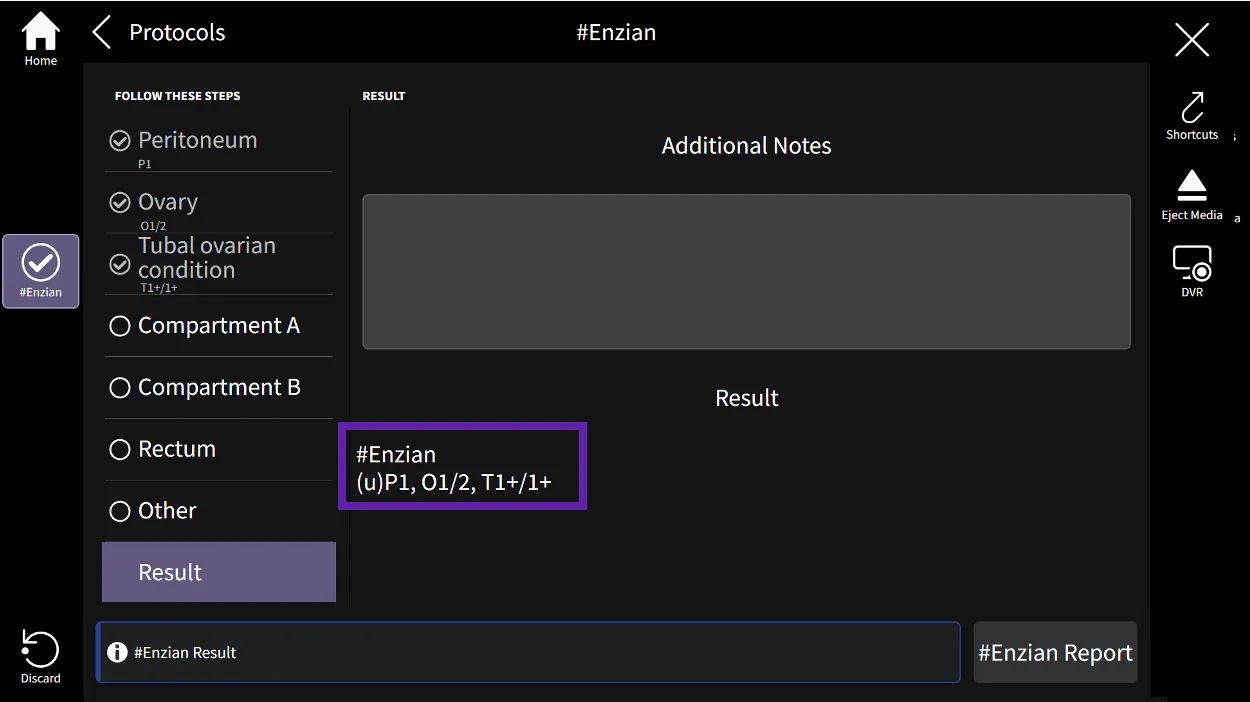
#Enzian P1, O2/1, T0, A1, B2/0, C1, FA
This indicates:
- A small peritoneal lesion (<3 cm)
- A moderate right ovarian endometrioma and a small left ovarian endometrioma
- No tubo-ovarian adhesions
- A small rectovaginal septum lesion
- Moderate right parametrial involvement with no left-sided involvement
- Small rectal involvement
- Presence of adenomyosis
This concise coding system allows complex disease patterns to be communicated quickly and consistently across the care team.
Building Confidence Through Experience and Training
A shared clinical language benefits both healthcare professionals and patients. For many women, transvaginal ultrasound offers a less invasive and more cost-effective first-line imaging approach for DIE assessment, while delivering sensitivity and specificity comparable to MRI.⁴
Achieving proficiency, however, requires dedicated training and practical experience. Clinicians must develop the ability to systematically evaluate pelvic anatomy, identify disease involvement, and accurately document findings according to the classification system.
One study reported that competency was typically achieved after approximately:⁵
- 17 scans for bladder DIE assessment
- 40 scans for rectosigmoid evaluation
- 25 scans for forniceal assessment
- 21 scans for rectovaginal septum evaluation
- 44 scans for uterosacral ligament assessment
Using a focused two-week training programme, clinicians worked towards an error rate below 4.5%.⁵
A Step Forward in Standardised Endometriosis Care
The #Enzian classification represents an important advancement in the evaluation and communication of deep infiltrating endometriosis. By combining a structured assessment framework with the accessibility of transvaginal ultrasound, clinicians can achieve more consistent disease mapping, support informed treatment planning, and strengthen multidisciplinary collaboration.
Mastering the #Enzian approach requires training, practice, and anatomical expertise. Yet with growing adoption and standardisation, it offers an important opportunity to enhance diagnostic confidence and help deliver more personalised care for women living with endometriosis.
References:
1.Cleveland Clinic. Deep infiltrating endometriosis. Updated September 15, 2025. Accessed July 8, 2026.
2.Keckstein J, Saridogan E, Ulrich UA, et al. The #Enzian classification: A comprehensive non-invasive and surgical description system for endometriosis. Acta Obstet Gynecol Scand. 2021;100(7):1165-1175. doi:10.1111/aogs.14099
3.Eichinger T, Oppelt P, Lastinger J, et al. Current Endometriosis Classifications (rASRM, #Enzian, AAGL2021) and their Correlation with Operative Time. Geburtshilfe Frauenheilkd. 2025;86(2):201-207. doi:10.1055/a-2697-6364
4.Daniilidis A, Grigoriadis G, Dalakoura D, et al. Transvaginal Ultrasound in the Diagnosis and Assessment of Endometriosis-An Overview: How, Why, and When. Diagnostics (Basel). 2022;12(12):2912. doi:10.3390/diagnostics12122912
5.Guerriero S, Pascual MA, Ajossa S, et al. Learning curve for ultrasonographic diagnosis of deep infiltrating endometriosis using structured offline training program. Ultrasound Obstet Gynecol. 2019;54(2):262-269. doi:10.1002/uog.20176