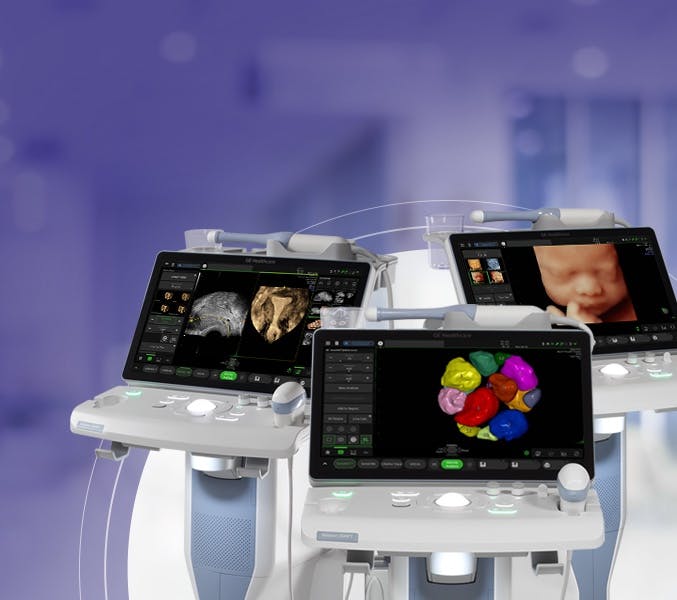
Enhancing Obstetrics with Third Trimester Ultrasound: Insights from Professor Khalil
Join Professor Asma Khalil from St. George's Hospital in Liverpool to learn more about the benefits of third trimester ultrasound in obstetrics.
Applications of Point of Care Ultrasound (POCUS) in Obstetrics
Ultrasound has multiple beneficial applications in obstetrics, particularly when paired with point of care tools. These uses include:
- Checking fetal viability
- Dating an early pregnancy
- Assessing fetal abnormalities
- Measuring amniotic fluid volume
- Determining if a pregnancy is a singleton or multiple
Later in pregnancy, clinicians can use ultrasound to identify potential placenta previa and determine fetal position and presentation before delivery.
Challenges of Third Trimester Obstetric Assessment
Placenta previa diagnosis and fetal presentation are important factors affecting both the mother and child during birth. A cephalic presentation of the fetus is required for the best outcome. However, in 3% to 4% of cases, there will be a breech fetal presentation by the end of the pregnancy (37 weeks and beyond). Typical obstetric ultrasound exams are performed twice for a low-risk pregnancy: a dating scan between 9 weeks and 13 weeks and a detail scan between 18 weeks and 22 weeks. In higher-risk pregnancies, such as those where there has been a placenta previa diagnosis, there are also additional ultrasound exams performed in the third trimester, known as follow-up growth scans. In situations where an obstetric ultrasound is performed in the late third trimester, the presentation of the fetus is documented, and breech positions are known and can be planned for.
Fetal presentation can change throughout pregnancy, so the most accurate assessment for presentation should be done in the late third trimester, close to delivery. However, only a small percentage of women receive an obstetric ultrasound at that stage in their pregnancy. Instead, a midwife or obstetrician commonly uses abdominal palpation to determine fetal presentation. Unfortunately, not all palpations correctly identify fetal presentation. This misidentification leaves healthcare providers to discover breech presentation cases during labor, which can result in an emergency cesarean section or unexpected breech vaginal delivery. Both of these outcomes carry significant maternal and fetal risk factors for perinatal mortality and morbidity, not to mention serious medical and legal implications.
Benefits of POCUS for Obstetric Care
Point of care ultrasound offers numerous benefits for obstetrician assessment, especially during the third trimester.
Improve Breech Presentation Diagnosis
A study performed in the UK found that a late pregnancy obstetric ultrasound could successfully screen for breech presentation and eliminate undiagnosed breech presentation in labor. This study also recommended that portable ultrasound systems could be a better option for these scans, as they were available at a lower cost and could integrate into the routine third trimester obstetric assessment performed by a midwife or obstetrician.
Another study published in 2023 compared the impact of the routine third trimester ultrasound performed by sonographers with point of care ultrasound exams performed by midwives on the incidence and proportion of undiagnosed breech presentations at term. This study found that both methods of third trimester presentation screening—by either a sonographer or midwife—identified and reduced the number of previously undiagnosed breech presentations and associated adverse perinatal outcomes by similar amounts. Routine third trimester ultrasound reduced undiagnosed breech presentations from 14% to 3%, and midwife-performed screening ultrasound decreased them from 16% to 3.5%.
Increase Accessibility of Obstetric Screening Exams
Point of care screening ultrasound for fetal presentation is easy and accessible enough that it doesn't have to be limited to doctors or sonographers. This user-friendly technology increases the accessibility of obstetric screening exams to help reduce patient wait times, maternal anxiety, and the risk of emergency cesarean sections and undiagnosed breech presentation in labor. This tool can also alleviate sonographer workload by allowing midwives and obstetricians to perform screening ultrasound exams.
Accelerate Care During Obstetric Emergencies
The fetus's heart rate must be checked by ultrasound during obstetric emergencies. However, it can take up to 2 minutes and 20 seconds to turn on and prepare the main ultrasound machine for a fetal heart rate assessment. A point of care ultrasound tool can complete this task in only 35 seconds, which is a significant benefit in an emergency.
Medical and Legal Implications of POCUS for Third Trimester Assessment
In the realm of obstetrics, the significance of third-trimester ultrasound could be a pivotal game-changer, especially when integrated with point of care sonography tools. Professor Khalil's comprehensive exploration of its myriad applications reveals a transformative landscape for intrapartum assessment.
The implications of accurately diagnosing placenta previa and fetal presentation during childbirth cannot be overstated, as they deeply influence both maternal and fetal outcomes. With fetal presentation prone to change throughout pregnancy, the late third trimester is a critical window for assessment. Unfortunately, only a minority of expectant mothers receive this screening. Relying on abdominal palpation, while a common practice, falls short in identifying fetal presentation accurately, leading to potential emergency scenarios during labor that carry substantial risks for both mother and infant.
Pioneering studies affirm the efficacy of ultrasound in screening for breech presentation during late pregnancy, advocating for portable ultrasound systems as a cost-effective, integrated approach in routine obstetric assessments. The democratization of obstetric screening among other healthcare providers reduces wait times. It also significantly improves care by decreasing the risk of unforeseen complications during labor and bridging the gap between specialist and non-specialist healthcare providers.
Training and Implementation of POCUS
Throughout her presentation, Professor Khalil advocates for the simplicity and accessibility of POCUS. To that end, she has developed an online training course with the Royal College of Obstetricians & Gynaecologists. This online course is tailored to accommodate midwives, nurses, and non-sonographers with a procedural approach for setup, registration, and scanning techniques, which democratizes access to vital diagnostic tools, ensuring accessible training with the goal of comprehensive patient-centered care.
In conclusion, Professor Khalil's illuminating discourse underscores the pivotal role of third trimester ultrasound in obstetrics. From its diverse applications to its role in mitigating risks and increasing access to crucial diagnostic tools, POCUS emerges not just as a technique but as a transformative asset in enhancing maternal and fetal healthcare outcomes, charting a path toward comprehensive and inclusive healthcare practices in obstetrics.
Interested in viewing Professor Khalil’s lecture? Click here: Point of care ultrasound in obstetrics.
Interested in learning more? View GEFOG’s lecture: Point-of-Care ultrasound in pregnancy: practical applications, governance and safe integration.