Predicting the Mode of Delivery by Angle of Progression
In the last few years, the ultrasound-measured angle of progression (AoP) has been validated as a useful predictor of the likelihood of spontaneous vaginal delivery. The AoP has also become a useful tool for managing occiput posterior presentations. In addition, the AoP can offer information about the success and safety of operative vaginal delivery and help predict the length of the second stage of labor. It has also been associated with lower rates of cesarean delivery in select populations.
Measuring AoP
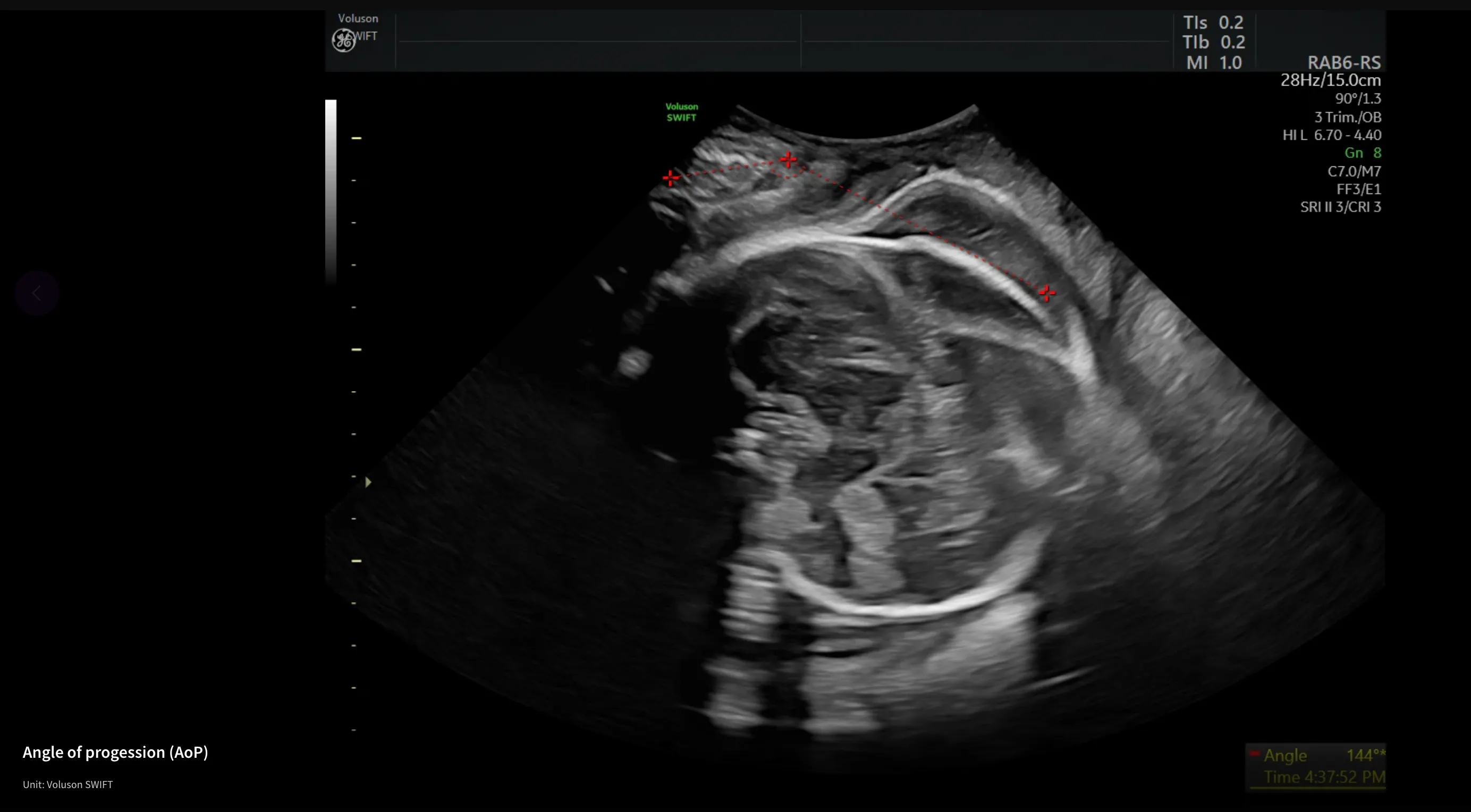
The AoP can be measured during the first and second stages of labor. Using transperineal ultrasound (TPUS), an image is acquired in the sagittal plane of the fetal skull and its relation to the pubic symphysis. A line is then drawn through the midline of the pubic symphysis (along its long axis), with a second line drawn from the lower edge of the pubic symphysis tangential to the presenting part — usually the fetal skull. The angle constructed between these two lines is the AoP.
This measured angle changes substantially from early labor to active labor. Researchers have studied the angle of progression at various times throughout prelabor and the labor period, but most studies have measured it at the end of the first stage of labor or the beginning of the second stage, after complete cervical dilation has occurred but prior to when pushing has started.
Angle of progression shown by Voluson SonoL&D
Predicting the Route of Delivery
In February of 2022, a meta-analysis of eight studies evaluating AoP was published in Ultrasound Obstetrics and Gynecology. The studies included 887 women with singleton, cephalic pregnancies who had the AoP measured just before pushing commenced. Researchers found that an AoP from 108° to 119° had the highest sensitivity for predicting subsequent vaginal delivery (80%) while an AoP from 141° to 153° had the highest specificity (82%).
The chances of a vaginal delivery grow with an increasing angle. The meta-analysis provided the following likelihood ratios (LRs) for clinical application of this data:
These positive and negative LRs can be utilized with a Fagan's nomogram to update the pretest probability of a vaginal delivery for a given patient in order to determine a positive and negative predictive value for vaginal delivery after the AoP has been measured.
Cesarean deliveries are considered safer when performed earlier in the labor process. Knowing that a patient will inevitably have a cesarean delivery could encourage care teams to perform it in a more timely manner, ultimately reducing the risk of complications. Although data are not precise enough to make certain recommendations about the preferred route of delivery, they can help inform conversations with patients and guide management decisions — particularly for abnormally progressing labors that have a higher pretest probability of cesarean delivery.
Predicting the Success of Operative Vaginal Delivery
In September of 2022, Ultrasound Obstetrics and Gynecology published another meta-analysis of seven studies that sought to evaluate the ability of the AoP to predict an uncomplicated operative vaginal delivery. The studies included 782 patients, with the AoP measured during the second stage of labor — some studies measured it between contractions with no maternal pushing effort, while others measured it with pushing during a contraction. The review concluded that the AoP was a reliable predictor of an uncomplicated operative vaginal delivery.
The study identified the predictive cutoff for a favorable AoP between 120° and 145.5° at rest and between 120° and 160.9° while pushing. Therefore, a "good" AoP would be greater than either 145.5° if measured without pushing or greater than 160.9° if pushing. Conversely, a poor predictor would be an angle less than 120°. Given these values, the authors found the following LRs could be used to predict the success rates for an uncomplicated operative vaginal delivery:
Fagan's nomogram can again be used with these values to predict success. For example, if a patient has a 65% chance of success before measurement, and the AoP is measured to be 110°, then the calculated chance after measurement of an uncomplicated operative forceps delivery would be only 17%, whereas if the angle were 146° (measured with no maternal pushing), then the chance of an uncomplicated forceps delivery would be 92%. Further research is needed to know which risks should preclude an attempted operative delivery, but these data add much to a previously subjective estimation.
A systematic analysis published in the American Journal of Obstetrics and Gynecology concluded that measurements of AoP conducted with pushing have a better prognostic value and also found that TPUS measurements of head-to-perineum distance were more accurate. Future research will focus on creating predictive tools that combine these and other data obtained from TPUS such as the rotation of the fetal head or the head direction-AoP ratio to help determine the best candidates for operative vaginal delivery instead of cesarean delivery.
Supporting Lower Rates of Cesareans
More recently, an October 2022 study evaluated the use of the AoP measurement for patients with uncertain fetal head engagement. One in 25 pregnancies with a prolonged second stage of labor (defined as greater than 2 hours) have uncertain fetal engagement on digital examination, particularly if caput succedaneum is present. In this situation, instrumental delivery is risky, and cesarean delivery is usually recommended; however, two-thirds of patients like this are capable of giving birth vaginally.
The authors conducted a randomized pragmatic trial centering on 45 patients. An independent investigator measured the AoP with pushing, and if AoP was >120°, the obstetricians were encouraged to attempt a vaginal birth. In the intervention group, the cesarean delivery rate was 12.5% compared with 41.1% in the control group with no differences in maternal or neonatal outcomes and no cases of failed operative vaginal delivery.
Using AoP in breech pregnancies
Even though the technique of measuring the AoP is defined by the line drawn between the fetal skull and the inferior aspect of the pubic symphysis, an accurate and reproducible AoP can be determined with breech presentations as well, according to a study published in October 2021. The clinical utility of this for the management of breech pregnancies has yet to be determined.
Predicting Vaginal Delivery in Occiput Posterior Labors
A study from January 2021 found that pregnant patients whose fetuses were in the occiput posterior position were more likely to undergo cesarean delivery and have persistent occiput posterior presentation if the AoP was less than 121.5°. This knowledge could guide the utilization of interventions such as manual or operative rotation.
Forecasting the Future of AoP
When a cesarean delivery is considered as an option for difficult labors, the transperineal ultrasound measured angle of progression may serve as a valuable tool to indicate which patients are likely to progress to a safe spontaneous or operative vaginal delivery. Current research is rapidly evolving to develop clinical predictive tools for this purpose. Patients with prolonged or protracted second stages of labor are most likely to benefit — and, in most cases, an AoP > 120° should be taken as a positive predictor for successful vaginal delivery. Angle of progression ultrasound data, along with continued research and study, will continue to serve an important role in the management of complicated labors.
Learn more:
Professor L. Poon’s lecture: Labour ultrasound for novice users.
Dr. L. Hinkson in this video: Ultrasound in labor and delivery – live demonstration.