The Fertility Journey: Sonohysterosalpingography for the Evaluation of Infertility
The use of sonohysterosalpingography instead of hysterosalpingography (HSG) to evaluate infertility is emerging as a viable alternative that is far less invasive, less expensive, and avoids ionizing radiation. According to a 2022 study, there is a global shift toward using office-based diagnostic methods in obstetrics.
The current fertility workup comprises multiple exams that obstetricians must perform during different phases of the menstrual cycle:
- An ultrasound assesses ovarian reserve
- HSG is performed for tubal patency
- Hysteroscopy assesses the uterine cavity
- Bloodwork is drawn for hormonal measurement
At times, patients may also need MRI and laparoscopy.
Because clinicians perform these different tests on different cycle days, "it's a bit difficult for the patient to be available for all the exams," says Michael Grynberg, MD, professor and Director of Reproductive Medicine & Fertility Preservation at Antoine Béclère University Hospital in Paris, France. "Some of the exams are invasive, such as laparoscopy."
Sonohysterosalpingography: A New Era in Fertility Assessment
With the advent of more advanced ultrasonography, "we now have more modern tools to perform an overall assessment of infertility," says Grynberg. Fallopian tube pathologies represent 25 to 35% of infertility, he says. "And most of these abnormalities came from obstruction of dilatation of the tube." Sometimes, though, abnormal tubal peristalsis due to infection, endometriosis, or previous pelvic surgery can also cause issues.
"Assessing tubal patency is mandatory for all female patients consulting for infertility, even if we know that there is a problem in the male," says Grynberg. The gold standard for evaluating tubal patency is laparoscopy with the blue test. "This involves a pelvic evaluation, sometimes diagnosis of endometriosis or an adhesion, but it's quite invasive and requires general anesthesia. There is some surgical risk, cost is relatively high, and it is not very easy to make a precise diagnosis of the site of the obstruction."
Because of this, clinicians typically perform hysterography (HSG) to assess tubal patency between cycle day eight and cycle day 13. However, HSG is quite painful for the patient, and healthcare providers cannot perform the procedure on patients with iodine allergies.
Sonohysterosalpingography is an ultrasound-based procedure meant to replace HSG to assess tube patency. There are two main types:
- Hysterosalpingo-contrast sonography (HyCoSy), which uses air plus saline serum
- Hysterosalpingo-foam sonography (HyFoSy), which uses specific hyperechogenic foam gels
Both HyCoSy and HyFoSy have clear advantages over HSG. These procedures have lower costs, are less invasive, and less painful for patients. That said, Grynberg finds HyFoSy to be better than HyCoSy, as HyCoSy does not offer a precise evaluation of the distal portion of the Fallopian tube. HyFoSy is non-invasive, has no embryotoxicity, and enables very precise information on the tube from the proximal to distal part. However, HyFoSy does not yield information on the uterine cavity due to the hyperechogenicity of the gel.
Using HyFoSy as Part of the Infertility Evaluation
In a 2017 Journal of Clinical Ultrasound study comparing HyCoSy and HyFoSy to laparoscopy with the blue test, HyFoSy yielded 94% concordance to laparoscopy, while HyCoSy yielded only 57%. A 2015 European Journal of Obstetrics, Gynecology, and Reproductive Biology study showed that 41% of tubes diagnosed with obstruction or inconclusive exams with HyCoSy were reclassified as patent following HyFoSy.
Grynberg observes that there has not yet been a randomized controlled trial comparing HyFoSy directly to HSG. But a 2017 BioMed Research International paper looked at nine small studies and concluded HyFoSy is a "well-tolerated, less painful procedure compared to HSG." The paper also reports that the procedure is a promising and safe alternative to reduce pain and avoid analgesics, radiation, and iodine exposure.
According to a 2018 study in the Australian and New Zealand Journal of Obstetrics and Gynaecology (ANZOG), the foam gel used in HyFoSy has been tested and shown no increased risk of allergy or infection with its use. It is also proven not to be teratogenic, says Grynberg, so there is no need for contraceptive use after the procedure. In fact, the 2018 ANZOG article notes that some pregnancies have been reported following the HyFoSy, as previously described following HSG. "So we know that this assessment of tubal patency, whichever way we perform it, HyFoSy or HSG, could have a therapeutic role," says Grynberg.
The Future of Infertility Evaluation
Using HyFoSy to evaluate tubal patency can help obstetricians assess fertility in a single visit and without anesthesia. "I believe we should be more modern in our assessment of infertility," says Grynberg. "We have options for performing just one ultrasound scan to assess the whole genital tract from the ovaries to the uterus and the tubes."
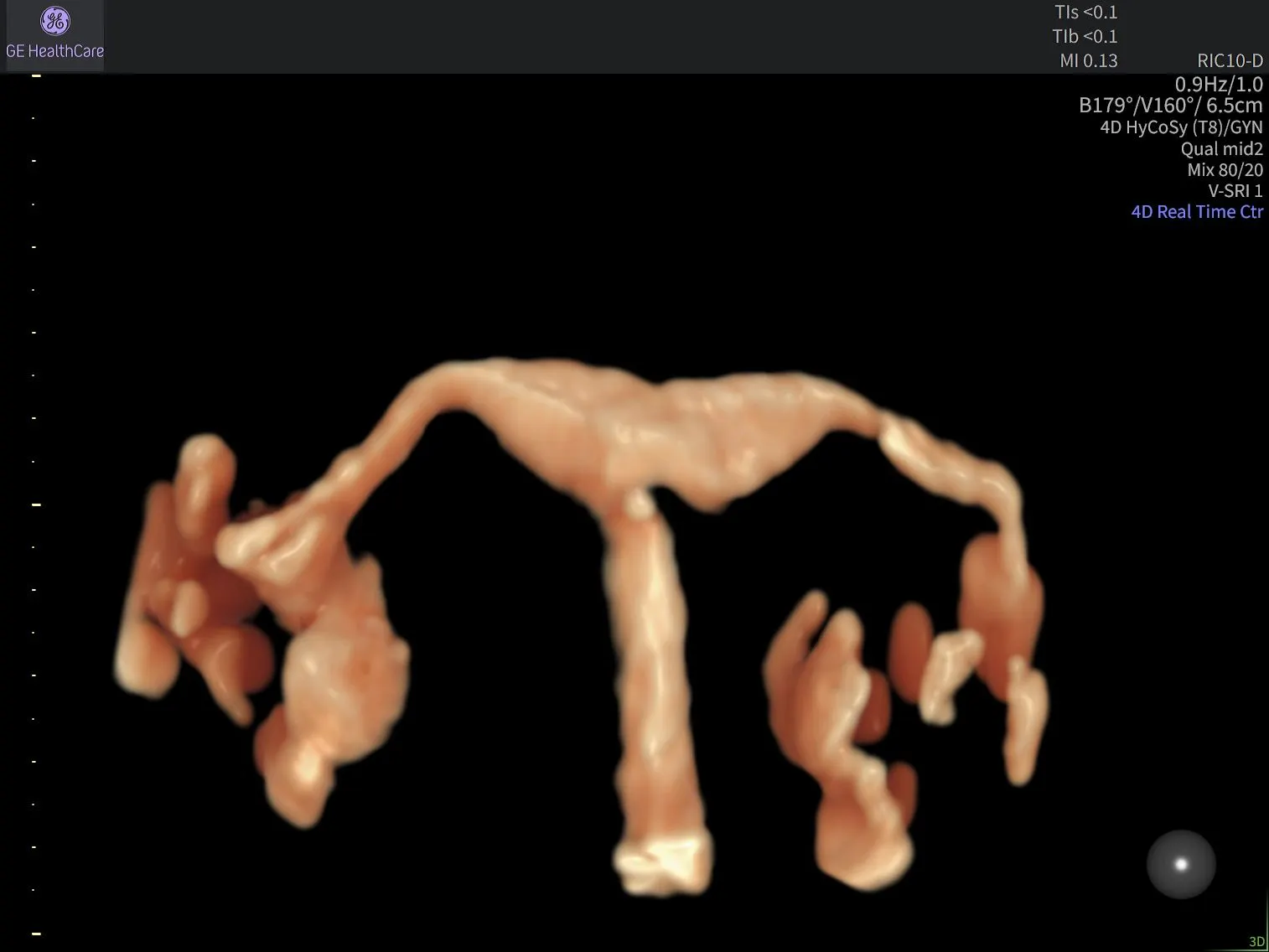
"Everything can be performed between cycle days six and eight," says Grynberg. During this visit, clinicians can draw bloodwork to assess ovarian reserve, and a single ultrasound scan covers the rest. He proposes beginning with a conventional 2D ultrasound followed by a 3D ultrasound with HyCoSy, administering saline serum through a small catheter placed just following the internal part of the cervix. "Then you go into the uterine cavity and administer some saline serum, and with the 3D reconstruction, we will be able to check the whole uterine cavity with the possibility of differential diagnosis of polyps and myomas," says Grynberg.
After HyCoSy, the clinician aspirates saline serum from the uterine cavity and starts the HyFoSy by administering the foam gel. "If you have two tubes patent, then you stop the exam—you're good," says Grynberg. "If one or two tubes are not patent, then you may need to re-perform the HyFoSy during the next cycle. If you have confirmation of one or both tubes not being patent, then you go for laparoscopy or IVF."
The future of infertility evaluation is here, and it's less invasive, less painful, and more streamlined for the patient. With one ultrasound scan and blood test, "you have your overall fertility workup for the patient," says Grynberg.
Interested in viewing Dr. Grynberg’s lecture, click here: Sonohysterosalpingography in fertility.