What's Next in Diagnostic Ultrasound: A Deep Dive into SonoLyst AI Technology
Welcome to the future of diagnostic ultrasound—SonoLyst is an AI-driven sonographic tool that has the ability to transform the obstetrical diagnostic ultrasound examination. In a field where accuracy and reliability are paramount, SonoLyst emerges as a game-changing innovation, promising enhanced diagnostic capabilities and redefining the norms of obstetrical assessment.
This article explores SonoLyst's multifaceted capabilities through the lens of obstetrical experts. These experts, each with a unique vantage point, shed light on distinct facets of SonoLyst, unveiling its potential to elevate obstetric ultrasound examinations to unprecedented heights. Through their insight and experiences, a comprehensive understanding of SonoLyst's technology and benefits emerges, illuminating its role in revolutionizing diagnostic ultrasound and shaping the future landscape of obstetric care.
Enhancing Exam Consistency and Workflow
SonoLyst represents a paradigm shift in obstetric ultrasound examinations by amalgamating advanced AI capabilities with the expertise of healthcare professionals through deep learning. Its core capabilities demonstrate a marked improvement in exam consistency and workflow efficiency. In fact, Dr. Aris Papageorghiou, director of research of the Oxford Maternal and Perinatal Health Institute, demonstrated that the SonoLyst AI system has been found to perform as well as an experienced sonographer in routine diagnostic ultrasound exams, acting like a virtual assistant that sits on one's shoulder to provide expert-level guidance and support.
One of the standout features lies in the potential time savings this tool offers, particularly evident in routine second trimester exams where SonoLyst demonstrates the ability to expedite procedures by up to 40%. This tool is completely automated, requiring very minimal interaction from the sonographer.
As a virtual assistant, it acts as a guiding force, only requiring a saved image to identify anatomy and take required measurements without any prompting. By swiftly and accurately identifying key structures, SonoLyst streamlines the examination process, empowering sonographers and clinicians to focus more on interpretation and patient care rather than spending excessive time on procedural aspects. This amalgamation of AI-driven assistance not only elevates accuracy in identifying fetal anatomy but also fosters a streamlined workflow, contributing to a more standardized and efficient diagnostic experience.
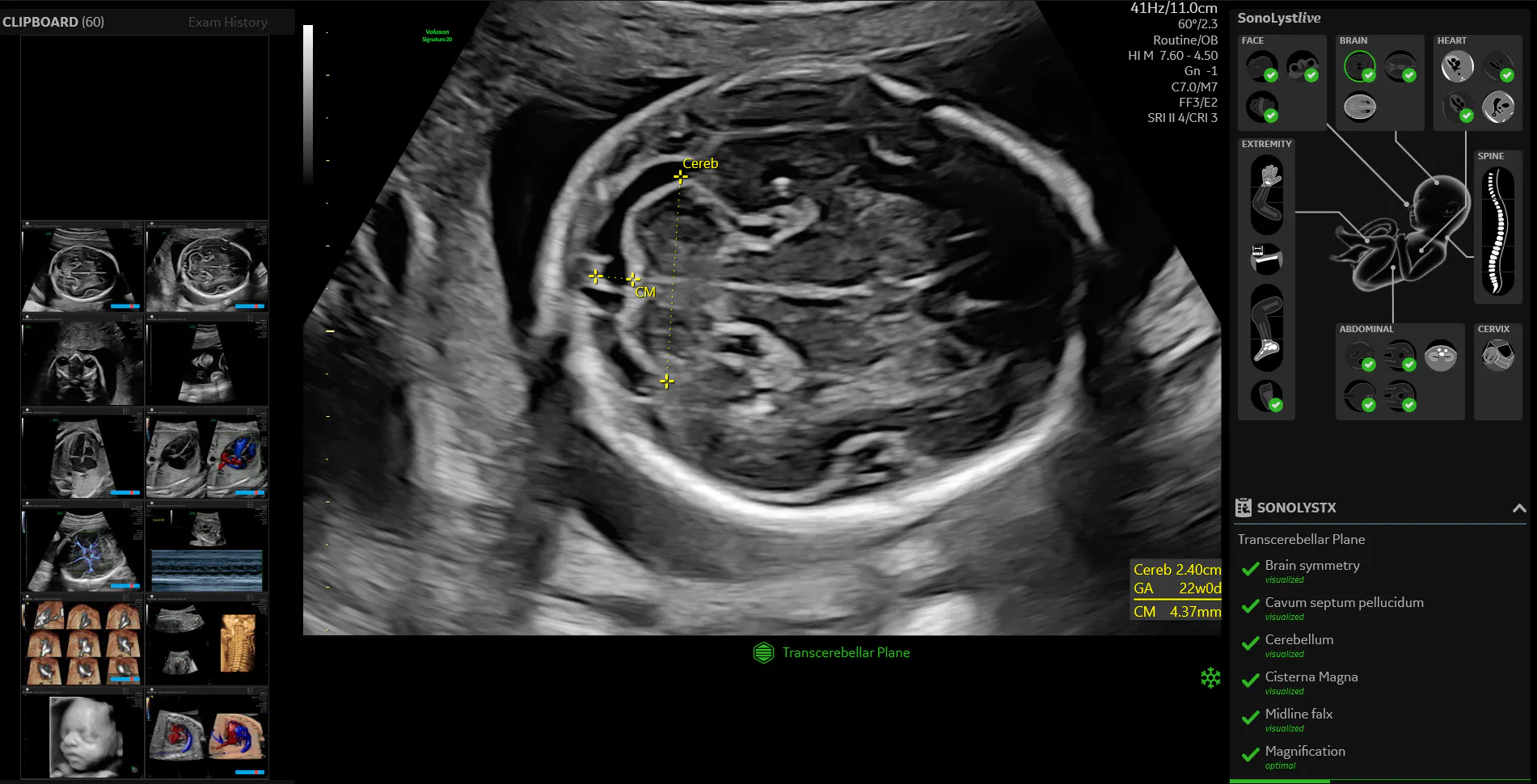
At the end of each ultrasound exam, the SonoLyst tool provides a checklist of all the images that have been completed and provides a quality score for each image, based on a minimum of four pre-programmed quality metrics for each image and scan plane. This quality control screening acts as a kind of peer review, reducing errors and oversights. Using this tool, clinicians can perform more obstetric scans not only more thoroughly but also with better image quality. This provides a significant increase in the scanning speed of exams, especially useful in the complex and time-consuming second trimester ultrasound exams.
The significant reduction in examination duration afforded by SonoLyst enhances efficiency as well as optimizes images throughout, allowing healthcare providers to allocate time more effectively and attend to a larger volume of patients.
Streamlining Image Recognition
SonoLyst stands at the forefront of image recognition technology within the realm of obstetric ultrasound, offering a groundbreaking solution to streamline and standardize diagnostic procedures. Ultrasound image pattern recognition and deep learning have been found to be particularly effective, often as effective as human pattern recognition, making this an excellent tool for use in complex and highly detailed obstetric ultrasound exams. This cutting-edge tool operates in accordance with the established guidelines set forth by the International Society of Ultrasound in Obstetrics and Gynecology (ISUOG), showcasing its capacity to automatically detect and identify the 20 recommended views essential for comprehensive fetal exams.
SonoLyst uses a clear checklist of images, which is visible in the top right of the ultrasound screen, and shows completion of all 21 images by the fulfillment of a circular status bar. By adhering to these practice guidelines, SonoLyst ensures a meticulous and thorough examination process, minimizing the chances of missing crucial anatomical structures and improving diagnostic accuracy.
Beyond its ability to identify requisite views, this technology significantly reduces operator variability, fostering a more consistent approach to obstetric imaging. This standardization enhances workflow efficiency by expediting the examination process and underscores the importance of precision and uniformity in diagnostic outcomes. Ultimately, SonoLyst's adherence to ISUOG guidelines embodies a transformative shift in obstetric ultrasound, offering enhanced diagnostic capabilities and a standardized approach that augments the overall quality and reliability of routine fetal obstetric ultrasound.
Skill Building and Quality Assurance
SonoLyst emerges as a multifaceted tool designed for skill enhancement and for maintaining impeccable imaging standards in obstetric ultrasound. This innovative platform operates as a comprehensive training aid, aligning with expert standards and experienced skills in the field. This tool helps to guide the clinician through the exam, showing them the next steps in the protocol and ensuring that each image is demonstrating the required criteria to meet minimum image quality requirements. It also incorporates a wealth of features that facilitate learning, including detailed anatomical diagrams and the integration of diverse image examples. These components are instrumental in enriching educational experiences, providing practitioners with a visual reference that helps in understanding fetal anatomy intricacies and abnormalities.
Moreover, SonoLyst serves as a stringent quality assurance mechanism, ensuring that imaging standards remain consistently high. By offering a platform for continuous skill refinement and assessment, it empowers healthcare professionals to hone their expertise while upholding high quality benchmarks.
Not only can SonoLyst improve scan quality for experienced sonographers, it can also be used as a training tool. Feedback on SonoLyst as a training tool for residents has been very positive. This heralds a shift from conventional ultrasound practices to a realm where cutting-edge technology is able to amplify the precision of diagnostic ultrasound for both new and experienced practitioners, which offers significant benefits for healthcare providers—and the field of obstetrics at large.
By combining educational support and quality assurance, SonoLyst is becoming an indispensable tool in the realm of obstetric ultrasound, fostering both skill development and unwavering diagnostic excellence.
Impact on Healthcare Providers and Patients
SonoLyst's integration into obstetric practices heralds transformative implications for healthcare providers and patients alike. For healthcare professionals, particularly sonographers and obstetricians, the introduction of SonoLyst translates to heightened efficiency and diagnostic precision. Its streamlined workflow and AI-powered analysis alleviate the burden of complex, detailed and repetitive tasks, allowing clinicians to focus more on clinical interpretation and patient care.
This technological leap promises enhanced diagnostic accuracy, enabling practitioners to complete routine ultrasound exams with dramatically improved efficiency and accuracy. For patients, the impact can be profound, especially concerning second trimester ultrasound scans. SonoLyst's heightened accuracy and speed translate into comprehensive and timely assessments, fostering early detection of potential complications or anomalies. This precise and early intervention bodes well for prenatal care, empowering expectant parents with crucial information and enabling healthcare providers to offer proactive, tailored care plans, thereby significantly enhancing overall patient outcomes and experiences throughout the pregnancy journey.
Click here to view Professor Papageourghiou’s lecture on The future of artificial intelligence and fetal medicine.