Performing a 3D GYN Exam Using Voluson SWIFT
This article will walk you through how to obtain a 3D ultrasound image using the Voluson™SWIFTultrasound system, accompanying a video that will show you a 3D Voluson SWIFT ultrasound exam performed on a patient with a partial septate uterus. With 3D imaging it is easy to diagnose a uterine malformation, demonstrating why 3D ultrasound is the gold standard.
Perform a 2D Scan
We always begin with a 2D scan. The 2D ultrasound scan allows us to obtain information on the position, dimensions, and echotexture of the uterus. It allows us to evaluate the endometrial echotexture from the fundus to the cervix, in sagittal and transverse planes. However, it does not allow for a complete evaluation of the uterine shape and cavity.
Acquire a Volume
3D ultrasound is based on the acquisition of a volume and not of single 2D images—it's 3D reconstruction of an image. Let's start with how to acquire an ultrasound volume. Remember, it's important to optimize the 2D image to obtain a good 3D image. If your 2D image is poorly defined or has shadows, you should first optimize the image before acquiring a volume.
Next, focus your attention on the area of interest, in this case the uterus. Reduce the box size to include only the uterus, fundus to cervix. During volume acquisition, multiple 2D images are added together as the ultrasound beam "sweeps" through the region of interest.
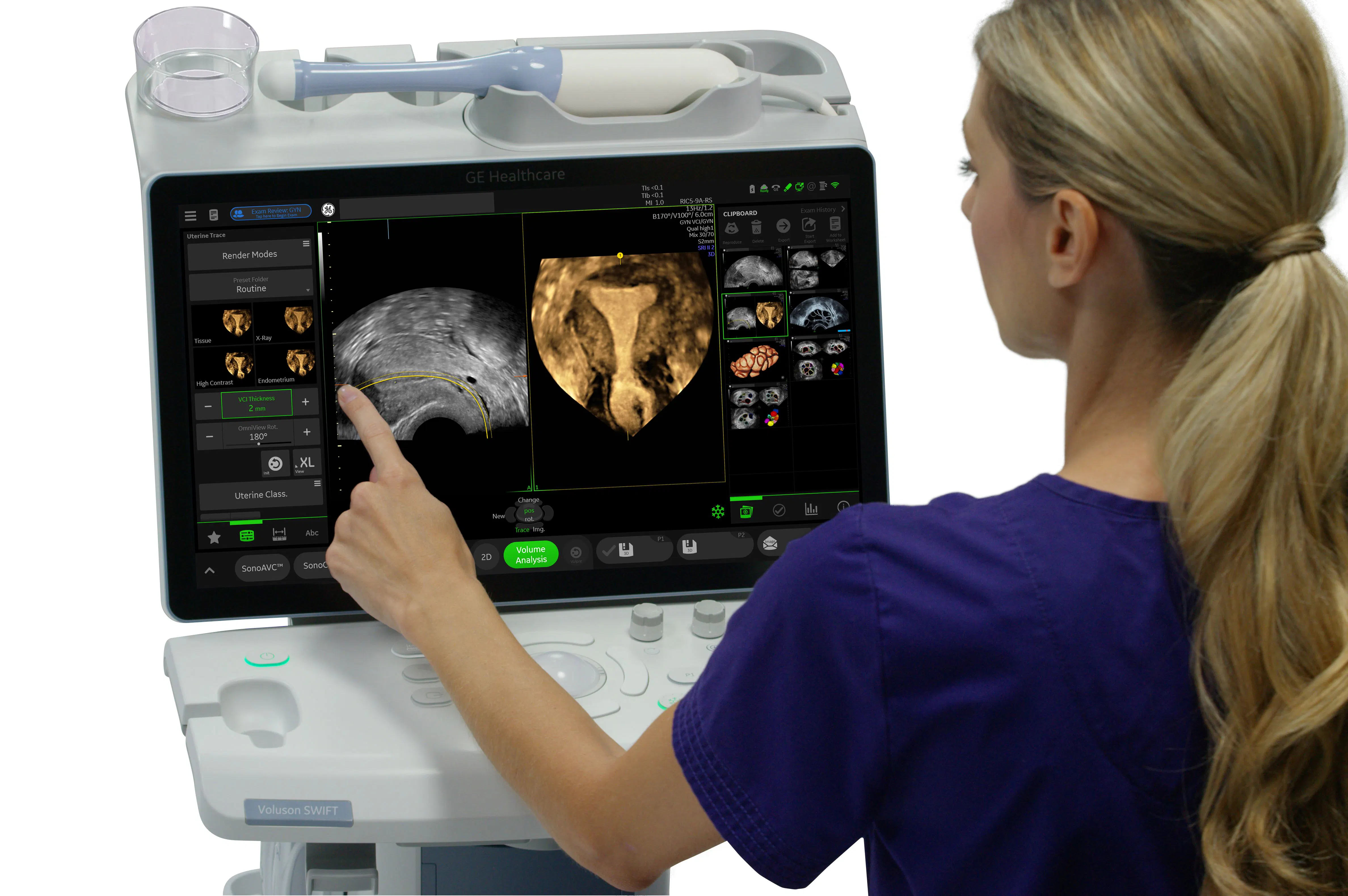
It should be emphasized that the uterus is a curvilinear organ, not a straight line, and best analyzed with a curvilinear tool. Using the Uterine Trace tool, it is possible to trace a line with your finger that perfectly follows the endometrial cavity and the cervical canal. A volume measurement allows an accurate evaluation of the entire uterine cavity.
Optimize the 3D Image
We have seen how to acquire a volume using Voluson SWIFT, now let's explore how to optimize the image.
3D is often associated with surface-rendered images, but it is also the multiplanar reconstruction displaying as three orthogonal planes. The A (X) plane displays the 2D image plane in which the volume was acquired and will provide the best resolution. The B (Y) plane displays the view perpendicular to the X plane, with a vertical orientation, and the C (Z) plane is perpendicular to the X plane, in the horizontal orientation. The C plane is the coronal plane and cannot be obtained in 2D.
In the A plane, place a dot or reference point in the center of the endometrium. Rotate to align the long axis of the endometrium with the horizontal plane, A (X). Then move to the B plane and position the dot in the center of the endometrium. Rotate, aligning the endometrial axis along the horizontal line (Z). Optimize the coronal view by placing the dot in the center to clearly visualize both of the cornua and the cervix.
To improve image quality, we may activate Volume Contrast Imaging (VCI). This optional feature increases contrast resolution and reduces artifacts, which is particularly important in evaluating the junctional zone.
More information can be obtained using different render modes. The fourth image is the rendered volume and can be displayed as a single, full-screen image. Explore various render modes, modify contrast and color, or, for the best display, use an endometrium or myometrium surface render mode.
We then complete the measurements required to diagnose a uterine malformation. First measure the interostial distance. Then measure the depth of the septum. The last measurement is the distance between serosa and the interostial line. This is the residual myometrium. These basic measurements allow us to diagnose a partial septate uterus.
Customer Insights
"This is the first true great revolution of ultrasound," says Dr. Brunella Zizolfi of the University of Naples Federico II in Italy. "It provides precise information on both the external and internal morphology of the uterus. Using the touch screen allows precise movements." She continues, "It is important to have a machine with advanced capabilities and functionality, but it is equally important to have the fundamental knowledge to use it at its best."